I took a run yesterday for the first time in a while. I went on my usual (long ago) route, and found myself struggling near the middle. Heavy chest, heavy legs. I kept telling myself; just get around this corner. Just get over that hill. Then you can take a rest.
On the next to last hill I was about spent. And then I remembered I trick I used long ago, to shift my perspective, as a way to keep running.
This is what I do: I imagine that I am in a train car, reading a book. The pounding of my chest and thumping of my feet are the sounds of the train. But I am taking the train to a distant town, so it is silly to focus on the engine. Better to imagine I'm sitting in the car, relaxing, enjoying the scenery. So I look around, ponder my own thoughts, or focus on the vanishing point of the trail ahead.
A friend long ago described the infinity pace as the pace that you can basically run forever. For someone as out of shape as me it is ludicrous, but still useful as a perspective. And as I shift into the infinity pace, the effort disappears. And then strangely, for the last single track stretch, I have a sprinter's energy.
As I settled back in my apartment, this perspective shift unlocked something that I've been struggling with in my recent adventure at UniversityNow, Inc. Building a company is hard work, both intellectual and emotional. And it is very easy to struggle with every hill. To get caught up in it. But that is where good practice and process come in. We use Agile, with its Iteration Planning Meetings, its backlogs, its retrospectives; these are the rhythmic feet pacing us down the trail. The process becomes subconscious and will get you up the hill.
Its when you look around at the contextual information that flows by, all of the data around you, and have a meaningful understanding of the destination, that the magic happens.
So to my startup friends out there: find your infinity pace. When you get in that flow you can let in the insights that make the difference. And you just might have the energy to sprint when it matters.
Sunday, June 24, 2012

Tuesday, April 19, 2011
The false divide of Enterprise and Consumer
These days consumerization of the enterprise is so oft-discussed it is almost passé; clearly enterprise software is borrowing tricks from the consumer web to the point where, in certain cases, they are becoming indistinguishable.
Yet people continue to think of companies as either consumer or enterprise. Isn't that itself old fashioned?
Let's tease apart what most people mean by this distinction when they ask:

I maintain that things have fundamentally shifted. When starting a company you can basically pick and choose the attributes you want, and you're an idiot if you choose too many from the Enterprise column.
Similarly, the people you assemble for the company need to come from background suited to the attribute, not the antiquated enterprise vs. consumer divide.
Here are the attributes for a couple of the opportunities I am looking at.

So I'm thinking the right question isn't enterprise or consumer. It is disruptive or disrupted. And I feel like there has never been a better time to be disruptive.
Yet people continue to think of companies as either consumer or enterprise. Isn't that itself old fashioned?
Let's tease apart what most people mean by this distinction when they ask:
I maintain that things have fundamentally shifted. When starting a company you can basically pick and choose the attributes you want, and you're an idiot if you choose too many from the Enterprise column.
Similarly, the people you assemble for the company need to come from background suited to the attribute, not the antiquated enterprise vs. consumer divide.
Here are the attributes for a couple of the opportunities I am looking at.
So I'm thinking the right question isn't enterprise or consumer. It is disruptive or disrupted. And I feel like there has never been a better time to be disruptive.
Thursday, April 7, 2011
Choosing my own adventure...
After two and a half years and many adventures at SAP, this chapter has drawing to a close. But like the fun books of our youth, the next chapter is not yet clear...
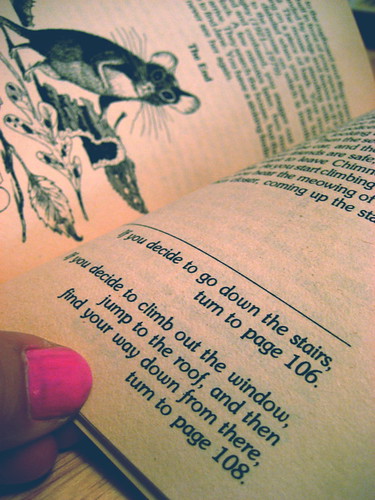
The stairs seem boring; the window seems right. I'll let you know when I figure it out.
Monday, December 20, 2010
On stage with Google's Scott McMullan at SAP Influencer Summit
Cross-posted here.
A couple of weeks ago Scott and I presented the Enterprise Edition of SAP StreamWork, and detailed its integration with the Google Apps Marketplace. The video is now posted to YouTube, and embedded here:
Highlights include:
A couple of weeks ago Scott and I presented the Enterprise Edition of SAP StreamWork, and detailed its integration with the Google Apps Marketplace. The video is now posted to YouTube, and embedded here:
Highlights include:
- Designed to extend: we show it extending SAP CRM
- You are in control: invite anyone who has an email address
- No friction: sign in with Google IDs.
- Small business friendly: on the Google Apps Marketplace
- Secure yet simple: Enterprise Agent deploys on-premise, handling security
Tuesday, December 14, 2010
Guest spots on DM Radio for Strategic Collaboration panel - SAP, SAS, and Acone
Originally posted here.
Last week I had the privilege to join a radio program with Information Management's DM Radio on Strategic Collaboration. I must say radio was a first for me but it was a lot of fun.
Eric Kavanagh and Robin Bloor of the Bloor Group co-hosted 3 panelists, discussing the new the battle "for where you work" and "your leisure time" which are developing a lot of overlap. The panelists were:
- myself, SAP
- Ed Hughes, SAS
- Dexter Bachelor, Acone
The SAP StreamWork part of the panel comes up at timecode 11:25 through about 26:45 as the first panelist. I talk a bit at the end as well, but since you can't jump forward you might not get there. And to keep things interesting I embedded the bingo works "kooky" and "umbilicus."
But you can register and download the MP3 if you'd like.
Thanks to Eric and Robin for a fun chat.
Thursday, December 9, 2010
StreamWork, Chatter, Yammer... What's the deal?
This week a bunch of us have been hunkered down in Santa Clara at the SAP Influencer Summit talking about SAP's strategy and execution. There were many questions about the relationship between SAP StreamWork and other tools like Chatter and Yammer. Perhaps it had something to do with that rave in SF featuring former presidents that happened on the same days.
Here are some specific questions I was asked:

Here are some specific questions I was asked:
- How are you going to compete with Chatter's adoption?
- Why is SAP doing this at all?
- Chatter is free; how do you compete with that?

StreamWork wants to connect the places you work to make you faster and better, while making your life simpler. It is targeted towards making short-term, powerful decisions and with all of the data and people at your fingertips. It is extremely well suited to "finishing off" the business process letting people handle all of the swirling chaos around it, involving the people and information that make sense.
But the questions, to me, are more fundamental. StreamWork doesn't want you to stop using the tools you love. It wants to flow them into the broader conversation and give you the world's best tools on top. StreamWork has a feed, but is not equivalent to a feed; it has the tools on top to get the work done.
Yet since the micro-blogging pattern has gained semi-ubiquity people think things that have activity streams should be compared. OK. But the fact is they enhance each-other. A portion of my tweets show up in Facebook; I don't choose which system to use, but I use them for different purposes, symbiotically. And my friends, we talk over this fabric, often from entirely different systems.
The world is federated, and it will remain so. If you want to pull together a federated conversation to drive it to action, you need to do a few things right:
But the questions, to me, are more fundamental. StreamWork doesn't want you to stop using the tools you love. It wants to flow them into the broader conversation and give you the world's best tools on top. StreamWork has a feed, but is not equivalent to a feed; it has the tools on top to get the work done.
Yet since the micro-blogging pattern has gained semi-ubiquity people think things that have activity streams should be compared. OK. But the fact is they enhance each-other. A portion of my tweets show up in Facebook; I don't choose which system to use, but I use them for different purposes, symbiotically. And my friends, we talk over this fabric, often from entirely different systems.
The world is federated, and it will remain so. If you want to pull together a federated conversation to drive it to action, you need to do a few things right:
- Complete openness -- This means people, data, human languages, programming languages, etc. Let's start with people. Let everyone in the world in for Free. No corporate email required. In fact, if you use gmail, you don't even have to sign in.
- Standards based -- Standards like ActivityStrea.ms allow micro-blogging systems to inter-operate. And it frees your data to use it how you want. You can use our cloud server as your feed server today using this standard, for free. Oh -- and it goes without saying that you should support OpenID, OAuth, SAML, and OpenSocial.
- Connected to the real stuff -- SAP customers touch your lives in many ways. They produce the food on your table, the drink in your glass, the power to your home. Odds are they touch your business. Don't you think your extended conversation needs access to those systems? With the new Enterprise Edition, your on-premise world is connected to your cloud-world. Let the data (and the real activities) flow.
- Rapid releases to improve, driven by user feedback -- If you like what we did this month, just wait until next month. If you don't like it, tell us, and we'll fix it. Openly and Transparently feedback driven.
- Be humble: People know how they want to work. Let them lead the way.
Friday, October 22, 2010
Passion or Greed? Organizing principles for Sustainability
(cross posted here)
When you search Google Images for Sustainability, you find this:

When you search Flickr for Sustainability, you find this:

Do you notice a difference? I do. And it is based on the organizing principles of Google Images and Flickr Images.
Google's business engine is advertising. Advertising intends to sell. The results from Google are images that people trying to sell you something they have made. Yes -- the ranking is all link-based, but anyone who has used Google over the last 10 years has noticed that the long tail has grown a lot quieter. The top results are very tied to commerce.
I would describe Flickr's business model as either Passion or Love. People photograph what they care about, and share the photographs with people they care about. It is emphatically human. That is why almost all of the results from Flickr have something that virtually NO images from Google have: Peace Plus One.

People, all over the world, are flashing this sustainability gang sign and I would wager that most of you sustainability zealots out there have never seen it, at least from the conversations I've been having. Why? They don't give you money. Peace Plus One is the understanding that we all must collectively improve our society, environment, and our economy. When SAP talks about sustainability, this is exactly what we are after. This is also what we report. We define it as the holistic management of social, environmental, and economic risks and opportunities for increased short- and long-term profitability.
Yes, we talking about profitability, but that is also an indication of efficiency (just as carbon reduction is), or lean-ness, or simplicity. I also like McDonough's counterpoint provocation: loving all children of all species for all time.
But really, it is simple. SAP's organizing principle is to make the world run better.
In other words, Peace Plus One FTW.
Thursday, September 23, 2010
A good week -- SAP Carbon Impact 5.0 and an update to SAP StreamWork go live...
I'd like to take a moment to celebrate two achievements this week - the tremendous 5.0 launch of SAP Carbon Impact - business software to manage your facility energy, or business carbon and lifecycle assessments, and an exciting update to SAP StreamWork - software for you to get work done faster, in a more natural way.
StreamWork has been helping people make better, faster team decisions since March, but we continue to rapidly innovate on it, based largely on your in-product feedback. Log in to see some of the updates in Friday's release, such as feeds and in-product IM. But here is the nut: you need to run better. Its tough out there. Work has gotten harder, we want to make it easier, we want you to flow. Know that there is more coming -- and there will always be. That is the beauty of continuous improvement that we manage for you, without a sputter, in the cloud. But for us to cater to your needs we need your feedback, so come on in and give it to us.
Oh, and by the way: software at work is getting a bit more fun, don't you think?
Wednesday, May 19, 2010
Watch that stream become a wave
Hello everyone!
We are excited to be working to support the Google Wave Federation Protocol in SAP StreamWork to let tools – collaboration or business – work seamlessly between any wave server, including Google Wave! With SAP StreamWork, we help business be more productive by letting people drive decisions together. Since our first BETA announcement a number of months ago we have been constantly compared to Google Wave, due to the real-time characteristics of the collaboration patterns we use. While products each have a different focus, they are also naturally complementary, and from the moment we saw Google Wave we were excited about the possibilities of connecting the two. This year’s Google I/O is our first opportunity to tell the story of how we plan to work collaboratively with Google, the Wave Federation Protocol, and OpenSocial.
For those of you who are not familiar with SAP StreamWork, it is aimed at transforming the way people work. When Google developed Google Wave it asked the question, “What would e-mail, instant messenger, and collaborative document creation look like if it were invented in the 21st century?” Similarly, SAP asked the question, “How can people solve important business decisions in a natural, fluid way, making every day more effective and fun?”. SAP StreamWork is a new on-demand, collaborative decision-making application that brings together people inside or outside your organization with information for fact-based decision-making and interactive business tools for collecting feedback, strategizing, and brainstorming, and is available today in a free version for anyone. It is also fully extensible by developers using open REST APIs.
Many of you make decisions every day, using a range of tools, from e-mail, to white boards, to shouting matches, to business applications and business intelligence. We get the work done, but it often becomes chaotic and hard to follow and can hinder clear decisions. Wave is modernizing collaborative communication; SAP is modernizing business. SAP StreamWork brings together people, information and proven business methodologies to help teams naturally and fluidly work toward goals and outcomes. Teams can assess situations together, develop strategies and make clear decisions, with a full record of what transpired. What better idea than to include anyone with a wave account?
So this is how we see you rolling in the near future: A supplier just notified you they couldn’t deliver materials that you need tomorrow to continue production. Crap! You bring that context fluidly into SAP StreamWork and assemble a team, bringing experts in that industry to see who might have capacity. Some of the people you know are registered as Google Wave users – instead of having to enter a different system, the business discussion complete with analytical and business tools show up in their wave inbox. It no longer matters where people are, or what tools they prefer – they can safely make decisions, in real-time, and directly drive the business applications that run the largest companies in the world. Now that feels like an improvement, yeah?
At this year’s Google I/O we will show the beginnings of this. But, what exactly, are we talking about?
Passing the Wave (Wave Federation):
At I/O we plan to show how SAP StreamWork has added a Wave Server to the platform to enable conversations between SAP StreamWork and other Wave servers. In SAP StreamWork a user starts an Activity where in they invite other participants to collaborate with them on a work activity like making a business decision. The group can then add the data and tools to guide them through the decision process. When an activity is created, StreamWork creates a new wave and federates the content of that Activity to the Wave server of any Wave users that may have been invited to that activity. With this integration Wave users will be able to seamlessly collaborate with SAP StreamWork users to work on the important decisions they need to make every day.
Go Go Gadget! (Gadget / Method Interoperability):
In order to ensure that content from an Activity or wave is properly federated between each other, we had to ensure that the content found in both systems was compatible with each other, and this included Wave Gadgets and StreamWork Methods. Wave Gadgets are shared programs that run inside waves, and are very comparable to StreamWork Methods which are business tools that run inside StreamWork Activities. Theproof of concept will show the compatibility between a StreamWork business method being federated over to Google Wave. We intend to create a generic compatibility between StreamWork Methods, and Wave and OpenSocial Gadgets so that developers will be able to ensure that gadgets or methods built for one system will work in the other.
These are the early days with our Wave Federation Protocol support and we are still in proof of concept stage, but we are excited to discover together with you how Wave, OpenSocial and StreamWork naturally extend each other, and we intend to deliver value to our customers, based on this work, within the next year. So please let us know your ideas, and we can figure out how the make the world a little more productive every day.
-David Meyer, SAP
We are excited to be working to support the Google Wave Federation Protocol in SAP StreamWork to let tools – collaboration or business – work seamlessly between any wave server, including Google Wave! With SAP StreamWork, we help business be more productive by letting people drive decisions together. Since our first BETA announcement a number of months ago we have been constantly compared to Google Wave, due to the real-time characteristics of the collaboration patterns we use. While products each have a different focus, they are also naturally complementary, and from the moment we saw Google Wave we were excited about the possibilities of connecting the two. This year’s Google I/O is our first opportunity to tell the story of how we plan to work collaboratively with Google, the Wave Federation Protocol, and OpenSocial.
For those of you who are not familiar with SAP StreamWork, it is aimed at transforming the way people work. When Google developed Google Wave it asked the question, “What would e-mail, instant messenger, and collaborative document creation look like if it were invented in the 21st century?” Similarly, SAP asked the question, “How can people solve important business decisions in a natural, fluid way, making every day more effective and fun?”. SAP StreamWork is a new on-demand, collaborative decision-making application that brings together people inside or outside your organization with information for fact-based decision-making and interactive business tools for collecting feedback, strategizing, and brainstorming, and is available today in a free version for anyone. It is also fully extensible by developers using open REST APIs.
Many of you make decisions every day, using a range of tools, from e-mail, to white boards, to shouting matches, to business applications and business intelligence. We get the work done, but it often becomes chaotic and hard to follow and can hinder clear decisions. Wave is modernizing collaborative communication; SAP is modernizing business. SAP StreamWork brings together people, information and proven business methodologies to help teams naturally and fluidly work toward goals and outcomes. Teams can assess situations together, develop strategies and make clear decisions, with a full record of what transpired. What better idea than to include anyone with a wave account?
So this is how we see you rolling in the near future: A supplier just notified you they couldn’t deliver materials that you need tomorrow to continue production. Crap! You bring that context fluidly into SAP StreamWork and assemble a team, bringing experts in that industry to see who might have capacity. Some of the people you know are registered as Google Wave users – instead of having to enter a different system, the business discussion complete with analytical and business tools show up in their wave inbox. It no longer matters where people are, or what tools they prefer – they can safely make decisions, in real-time, and directly drive the business applications that run the largest companies in the world. Now that feels like an improvement, yeah?
At this year’s Google I/O we will show the beginnings of this. But, what exactly, are we talking about?
Passing the Wave (Wave Federation):
At I/O we plan to show how SAP StreamWork has added a Wave Server to the platform to enable conversations between SAP StreamWork and other Wave servers. In SAP StreamWork a user starts an Activity where in they invite other participants to collaborate with them on a work activity like making a business decision. The group can then add the data and tools to guide them through the decision process. When an activity is created, StreamWork creates a new wave and federates the content of that Activity to the Wave server of any Wave users that may have been invited to that activity. With this integration Wave users will be able to seamlessly collaborate with SAP StreamWork users to work on the important decisions they need to make every day.
Go Go Gadget! (Gadget / Method Interoperability):
In order to ensure that content from an Activity or wave is properly federated between each other, we had to ensure that the content found in both systems was compatible with each other, and this included Wave Gadgets and StreamWork Methods. Wave Gadgets are shared programs that run inside waves, and are very comparable to StreamWork Methods which are business tools that run inside StreamWork Activities. Theproof of concept will show the compatibility between a StreamWork business method being federated over to Google Wave. We intend to create a generic compatibility between StreamWork Methods, and Wave and OpenSocial Gadgets so that developers will be able to ensure that gadgets or methods built for one system will work in the other.
These are the early days with our Wave Federation Protocol support and we are still in proof of concept stage, but we are excited to discover together with you how Wave, OpenSocial and StreamWork naturally extend each other, and we intend to deliver value to our customers, based on this work, within the next year. So please let us know your ideas, and we can figure out how the make the world a little more productive every day.
-David Meyer, SAP
Monday, February 15, 2010
Beware the Water Hammer
Water Hammer: a pressure surge or wave resulting when a fluid (usually a liquid but sometimes also a gas) in motion is forced to stop or change direction suddenly (momentum change). Water hammer commonly occurs when a valve is closed suddenly at an end of a pipeline system, and a pressure wave propagates in the pipe.
They say everything you need to know you learned in Kindergarten. I still managed to learn a little in later years, including my graduate years studying water. But the concept is the same -- the world is full of patterns, and systems begin to look alike regardless of the discipline.
Which brings me to my point: driving change in an organization has analogies to driving change in a fluid system. The people dynamics have corollaries in fluid dynamics. People have momentum and fluids have momentum.
When you close a valve in a water system, it is easy to congratulate yourself for your success. No water is passing! I have changed the system! Problem solved. But depending on the system, seconds or minutes or hours later you might be dead. Explosions, ruptures, and implosions, sometimes deafening and disastrous, can be your end. Why? The accumulated momentum in the system is hard to stop. You have to think of all of the water, all the way upstream, and determine where all of that momentum will be absorbed.
In working on 12sprints, we had to change the system of SAP to account for some of our new models. Elastic subscription services have a ton of ramifications for a traditional software company, from accounting to legal to privacy to support, and every time we reached a decision (closed a valve / redirected flow) we learned that other parts of the system had momentum we hadn't anticipated. And were there explosions? That would be too strong a word, but there definitely turbulent debates and some bent metal in the expansion joints.
My conclusion? Change is a lifestyle. It is a lifestyle only survived by being relentlessly attuned to the rest of the system, and using a simple recipe when the pressure builds: be open, creative, and luckier than most.
And always wear waterproof clothing.
Tuesday, May 12, 2009
Where's that confounded data?
Where did I put that data again?
I get data in email attachments, in PowerPoint, in Excel, in Crystal Reports. I read data on the web. I get data on phone calls, over IM, from the mouths of customers. I hear about data that other people have and ask, sometimes timidly, for a copy. Like my brother’s MP3 hording I want to have it, just in case. There is a comfort in having all of this data. That is, until I need to find it.
Finding data is hard. With Draconian email quotas and the difficulties of searching archives, it always becomes lost. I can find my music now in iTunes, but what about my data?
More and more I use two very different tools to help me survive this information-saturated world: Evernote and SAP BusinessObjects Explorer. Think of Evernote as your external brain, where you can store your every thought for perpetual retrieval, and Explorer as your company’s external brain, where every last bit of data can be retrieved instantly. I'll talk more about Evernote later, but this week seems to be all about BusinessObjects Explorer.
Yes, this week SAP BusinessObjects Explorer is being launched, but the technology antecedents to this powerhouse have been around a while. It is comprised of a product previously known as BusinessObjects Polestar and some cutting-edge in-memory acceleration technology previously manifested in SAP Business Warehouse Accelerator. Yet it is their combination is truly stunning.
I am an impatient man. I love my Mac since I open it up and it is ready with no delay – I cannot wait for something to boot. I have loved using Explorer over the last year since I can hit a web page and answer my questions as soon as I ask them – I don't have to wait for someone to build a report. I just have a conversation:
You say revenues are bleak for a certain product in the United States? Let’s look at it by city. Whoa. San Francisco and Washington are down, when they are up for the rest of the business. Let’s get California sales on the phone and see what’s happening – send them the link. Richard, what’s going on here? Oh, we didn’t run the right campaign? Let’s budget for that next quarter, it showed good results everywhere else.
[caption id="attachment_201" align="aligncenter" width="500" caption="Fun with Data"]
 [/caption]
Bingo. In a 60 minute meeting, we can have 5 conversations like that, and have discussions based on substantive fact. Coming from the data-desert of past jobs, this kind of knowledge oasis is intoxicating.
Yet combined with the in-memory technology the potential is breathtaking. Terabytes are now your friend, they are not demons threatening to slow your life to a crawl. Petabytes are an afternoon snack. You don’t have to look at statistical samples, you can look at the truth.
So as I index the world around me, play a little for yourself online. See what it is like to manipulate 1000 rows of Excel in this remarkable tool. And then imagine what it would be like to manipulate the world. That is, if you can handle the truth.
Wednesday, May 6, 2009
Torture is bad, everywhere.
In Torture, Plain and Simple, Suzanne points out that while it is true that torture doesn't work, it doesn't matter: it's illegal. But let's dwell for a minute on the first point: torture doesn't work.
Elaine Scarry gave this subject a scholar's attention in The Body in Pain, where she explained that pain nullifies the world around us -- with extreme pain nothing exists but the pain. This deconstructs the ego to a point where conversation is meaningless and information extracted in this state has one goal: to make the pain stop. Say anything to make the pain stop. In fact, there is a long history of torture being used to extract misinformation to support campaigns of misinformation.
While this simple fact is well established in research, it seems appallingly under communicated. If it was well communicated, I imagine it would lead to this:
The complex ethics simply disappear.
Elaine Scarry gave this subject a scholar's attention in The Body in Pain, where she explained that pain nullifies the world around us -- with extreme pain nothing exists but the pain. This deconstructs the ego to a point where conversation is meaningless and information extracted in this state has one goal: to make the pain stop. Say anything to make the pain stop. In fact, there is a long history of torture being used to extract misinformation to support campaigns of misinformation.
While this simple fact is well established in research, it seems appallingly under communicated. If it was well communicated, I imagine it would lead to this:
Interrogator 1: Should we do it?
Interrogator 2: Well, it doesn't work.
Interrogator 1: OK then, let's not bother.
The complex ethics simply disappear.
Monday, May 4, 2009
The Art of Trust
I was about to tweet about some happy cows I saw while driving to work today, until I remembered the law and thought better of it. The cows weren't worth a ticket. But aside from the desire to avoid tickets and stay alive, there is another hazard of automotive texting - thumbing the wrong key and sending the wrong message, perhaps to the wrong person.
When I hired a guy last year entirely over SMS I committed a gaffe - I received a Twitter DM (direct message) and hit reply, sending the reply to all of my followers. This is a variant of a DM Fail, when people think they are sending a message to just one person but instead broadcast it widely. In my case I uttered something relatively harmless like "req opened this week."
Something more nefarious happened recently on Twitter: they actually sent DMs to the wrong people, detailed in TechCrunch. Jason accurately called this a "breach of user trust," but it was resolved quickly. Twitter is not alone here. A colleague of mine was using an esteemed Web2 product when they one day got a trove of someone elses messages dumped on their desktop over IMAP. Only once, but once is all it takes.
When I hired a guy last year entirely over SMS I committed a gaffe - I received a Twitter DM (direct message) and hit reply, sending the reply to all of my followers. This is a variant of a DM Fail, when people think they are sending a message to just one person but instead broadcast it widely. In my case I uttered something relatively harmless like "req opened this week."
Something more nefarious happened recently on Twitter: they actually sent DMs to the wrong people, detailed in TechCrunch. Jason accurately called this a "breach of user trust," but it was resolved quickly. Twitter is not alone here. A colleague of mine was using an esteemed Web2 product when they one day got a trove of someone elses messages dumped on their desktop over IMAP. Only once, but once is all it takes.
Friday, April 10, 2009
The Downside of "Efficiency"
Preamble: I started this post over 3 months ago, so many of the links are a bit dated. I decided to finish it up ad post it since this very delay illustrates the point I'm making: in a highly stressed system, where all capacity is consumed, minor additional stress can make a system collapse. That feels a lot like work today, where budgets have been cut, and we all have to do more. So we lose time to think, let alone blog.
---
Times are tough. Buckle down. Buck up. Be lean. Be efficient. Do more with less.
Yes, Indeed. But before we all become super-efficient pieces of a super-efficient machine let's take a moment for pause. Because there is a downside of efficiency (or at least what the world around us often calls 'efficiency')
I think it was in graduate school when it first became clear to me that efficiency was great until there was a problem, and then it wasn't so great. I was studying complex water systems, and how to manage them to leverage the most capacity (electrical and consumption) while preserving fish happiness and keeping the land pretty. Once you balance all of the uses into a finely tuned system, and make it reliable, people will build complex systems around that reliable water, and if it isn't there... well complex systems start to break down.
What this amounts to is setting up systems to have the butterfly effect, since making systems more efficient generally creates more complex dependencies.
Consider George Monbiot's recent interview with Fitah Birol's, Chief Economist of the International Energy Agency. Much of the world's governments rely on assessments of the IEA regarding how long oil supplies will last, and it turns out they now think they were off, but only by a factor of 2. They had modeled a decline in output of 3.7% per year, which they now think is 6.7% per year. And we're using more. So we'll be running out around 2020. This means that "unconventional" sources of oil, like tar sands, would need to be processed into oil to keep the machine running, but don't worry: that would only amount to an environmental catastrophe. It is similar to the phases of drilling in conventional wells, where primary, secondary and tertiary recovery start to require more resources, be worse for the environment, etc.
Or consider the minor business dispute between Russia and Ukraine that led to freezing out Slovakia, the Czech Republic, Austria, Hungary and Romania over the past few days. As gas flows efficiently between regions, complex systems begin to rely on it, so it better keep coming.
In other words: efficiency increases output, output begets demand, demand requires continued output, and the scenarios of Too Big to Fail, or the corollary, Too Big to Exist.
To my friends who work in software this is just obvious: we are asked to use resources "more efficiently" all of the time, which usually means very little spare capacity to handle unexpected events. And the software business = unexpected events.
So my solution? I endeavor to become less busy. Take more breaks. Chew food slowly. Say no. Which will of course require and enable "true efficiency," but it might not look like that on the books. And, of course, will never happen.
---
Times are tough. Buckle down. Buck up. Be lean. Be efficient. Do more with less.
Yes, Indeed. But before we all become super-efficient pieces of a super-efficient machine let's take a moment for pause. Because there is a downside of efficiency (or at least what the world around us often calls 'efficiency')
I think it was in graduate school when it first became clear to me that efficiency was great until there was a problem, and then it wasn't so great. I was studying complex water systems, and how to manage them to leverage the most capacity (electrical and consumption) while preserving fish happiness and keeping the land pretty. Once you balance all of the uses into a finely tuned system, and make it reliable, people will build complex systems around that reliable water, and if it isn't there... well complex systems start to break down.
What this amounts to is setting up systems to have the butterfly effect, since making systems more efficient generally creates more complex dependencies.
Consider George Monbiot's recent interview with Fitah Birol's, Chief Economist of the International Energy Agency. Much of the world's governments rely on assessments of the IEA regarding how long oil supplies will last, and it turns out they now think they were off, but only by a factor of 2. They had modeled a decline in output of 3.7% per year, which they now think is 6.7% per year. And we're using more. So we'll be running out around 2020. This means that "unconventional" sources of oil, like tar sands, would need to be processed into oil to keep the machine running, but don't worry: that would only amount to an environmental catastrophe. It is similar to the phases of drilling in conventional wells, where primary, secondary and tertiary recovery start to require more resources, be worse for the environment, etc.
Or consider the minor business dispute between Russia and Ukraine that led to freezing out Slovakia, the Czech Republic, Austria, Hungary and Romania over the past few days. As gas flows efficiently between regions, complex systems begin to rely on it, so it better keep coming.
In other words: efficiency increases output, output begets demand, demand requires continued output, and the scenarios of Too Big to Fail, or the corollary, Too Big to Exist.
To my friends who work in software this is just obvious: we are asked to use resources "more efficiently" all of the time, which usually means very little spare capacity to handle unexpected events. And the software business = unexpected events.
So my solution? I endeavor to become less busy. Take more breaks. Chew food slowly. Say no. Which will of course require and enable "true efficiency," but it might not look like that on the books. And, of course, will never happen.
Subscribe to:
Posts (Atom)